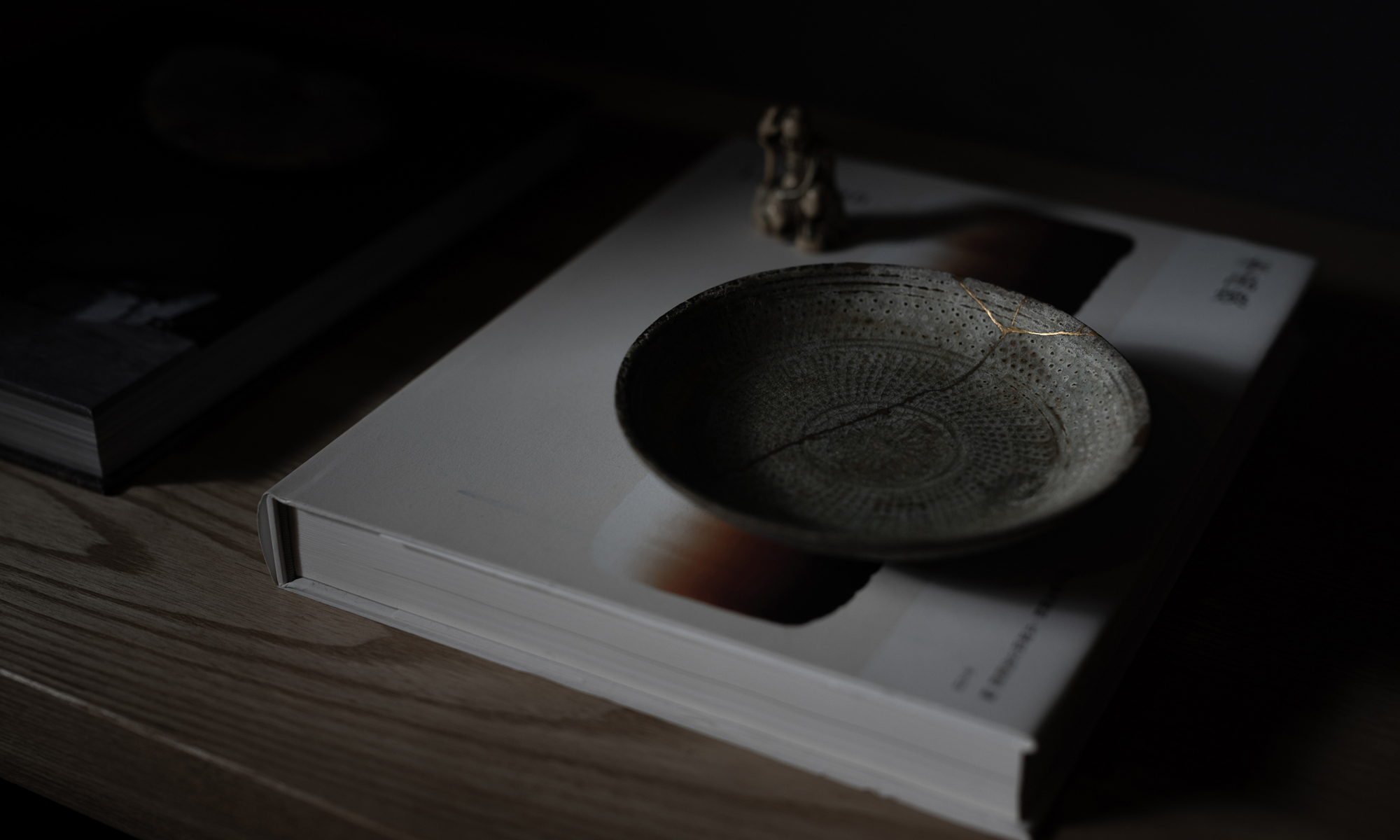

YACCA is a kintsugi studio based in Fukuoka, Japan. More than 200 objects are handled each year for a wide range of clients, including Michelin-starred restaurants, renowned ceramic artists, galleries, and collectors.
The online gallery grew out of this restoration practice, bringing the same experience and approach to historical ceramics and objects selected, researched, and restored for a new context.
Selected Projects
1. Restoration of Six Works by Sajiro Tanaka
Following Sajiro Tanaka’s 2024 solo exhibition at Nihombashi Mitsukoshi in Tokyo, we were entrusted directly by Tanaka with six works that had already been sold and were awaiting delivery to their new owners: three tea bowls, two sake bottles, and one sake cup.
Each work had minor issues that had occurred during the making or firing process, including small chips and, in some cases, water leakage. The chips were filled using an urushi-based material made with lacquer and tonoko, then finished with 24K gold.
For the works that did not fully hold water, urushi was carefully introduced into the affected areas to seal the leaks. Particular care was required to prevent the lacquer from spreading into the surrounding ceramic body and causing visible staining.
The works had been exhibited at Nihombashi Mitsukoshi’s Special Selection Gallery, a venue known for presenting solo exhibitions by leading Japanese artists, including recipients of the Order of Culture and Living National Treasures. Because all six works had already been acquired and were awaiting delivery, the repairs required an especially high degree of care and precision.
About Sajiro Tanaka
Sajiro Tanaka (b. 1937) is a Kyushu-born ceramic artist known particularly for his work with Karatsu and tea ceramics. His practice is deeply informed by the study of ancient ceramics, Zen Buddhism, and the traditions of the tea ceremony.
In 2016, his work was presented by Joan B. Mirviss in New York alongside that of Living National Treasure Ishiguro Munemaro in Poetic Reflections: Ishiguro Munemaro and Tanaka Sajiro. In 2026, he was included in the gallery’s Six Celestials, together with Tomimoto Kenkichi, Kawai Kanjiro, Ishiguro Munemaro, Kamoda Shoji, and Okabe Mineo.
The catalogue for Tanaka’s 2024 exhibition at Nihombashi Mitsukoshi also lists former British Prime Minister Margaret Thatcher and former Japanese Prime Minister Yasuhiro Nakasone among collectors of his work.
2. Restoration of Two Sake Bowls by Kentarou Murayama
Among the forms Kentarou Murayama has been exploring in recent years is the shuwan, a small bowl derived from the form of a travelling tea bowl and developed as a new form of high-end sake vessel for contemporary Japanese sake culture. Conceived to bring together function, artistry, and the experience of drinking sake, each bowl is made as an individual work of contemporary ceramics.
We were entrusted directly by Murayama with two of these sake bowls for repair.
One, a Madara Karatsu bowl, had a scar left after the removal of a kiln adhesion formed during firing. The damaged area was levelled using urushi and tonoko, following the same process used for a conventional chip repair, and finished with 24K gold.
The second bowl had developed a deep kiln crack running from beside the foot into the body. Rather than filling the fissure flush with the surrounding surface, we felt that its depth formed part of the character created by the firing process. We therefore deliberately kept the repaired surface slightly recessed, allowing the 23.2K gold finish to remain visible within the depth of the fissure.
The repaired Madara Karatsu sake bowl was later featured in Honoh Geijutsu No. 166. First published in 1982, Honoh Geijutsu is a long-established Japanese quarterly devoted to ceramics and is read by ceramic enthusiasts and collectors in Japan and abroad.
About Kentarou Murayama
Kentarou Murayama (b. 1978) is a ceramic artist based in Karatsu, Saga Prefecture, one of Japan’s historic centres of ceramic production.
His practice begins with materials gathered directly from the landscape around Karatsu. He collects clay, stone, and iron himself, refining them into the clay bodies and glazes used in his work. Central to his approach is the idea that a vessel leaves the kiln only “eighty percent complete,” with the remaining part formed gradually through use and the passage of time.
Murayama established his own kiln and studio in Karatsu in 2008. In 2026, Time & Style Amsterdam presented his solo exhibition Beauty Through Use, bringing together approximately 1,000 works and introducing his practice in the context of Karatsu’s 450-year ceramic tradition.
3. Lecture at the Omotesenke Domonkai
In August 2023, YACCA was invited to give a 90-minute lecture titled Kintsugi: Tea and the Spirit of Repair as part of a public cultural program organized by the Omotesenke Domonkai.
More than 300 people attended the lecture. Beginning with fundamental questions — why gold came to be used in kintsugi, and what other forms of ceramic repair have existed in Japan — the talk went on to explain the individual stages of traditional urushi-based kintsugi in detail.
The final part of the lecture focused on the wider culture surrounding urushi: the lacquer itself, the specialist materials and crafts that support it, and the challenges these traditions face today.
What we hoped to convey was that kintsugi can be more than an interest in repaired ceramics. It can also become an entrance into the much broader culture of urushi — and, in a small way, help carry that culture forward.
About Omotesenke and the Domonkai
Omotesenke traces its tea tradition directly to Sen no Rikyu, the 16th-century tea master who profoundly shaped the development of wabi-cha. Today, more than four centuries after Rikyu, the tradition continues under the 15th-generation iemoto, or head of the school, Sen Sosa.
The Omotesenke Domonkai is an association of people who study and support the Omotesenke tradition. With branches throughout Japan and overseas, it works to preserve and share the culture of chanoyu through tea gatherings, lectures, training programs, and other cultural activities. Its public lecture series was established to introduce the culture of tea to a wider audience, including people who do not formally practice chanoyu.
4. Restoration of a Meiping from Taishu Kiln
During a visit to Tsushima for a shoot for HIRUKO, our kintsugi pearl jewelry brand, we visited Taishu Kiln and met its current head. Some time later, a meiping from the kiln was brought to our studio for repair.
The vessel had a kiln crack at the base that allowed water to leak through. We sealed the crack with urushi, carefully controlling the application to restore its ability to hold water without altering the appearance of the vessel more than necessary.
About Taishu Kiln
Tsushima lies between Japan and the Korean Peninsula, and its ceramic history has long been closely connected with Korean ceramic traditions.
In 1981, ceramic artist Togo Kobayashi revived Taishu Kiln on the island. Kobayashi had travelled to Korea in 1973 to study Korean ceramics and became particularly known for works drawing on traditions including Ido, kohiki, Mishima, and hakeme. He exhibited widely in Japan, including at Nihombashi Mitsukoshi in Tokyo. His work continues to be presented internationally; in 2024, a kohiki water jar by Kobayashi was exhibited by Dai Ichi Arts during Asia Week New York.
After Kobayashi left Tsushima, local supporters sought to continue the kiln. Taishu Kiln was subsequently re-established under Kobayashi’s guidance and continues its work on Tsushima today.
In 2014, the revived Taishu Kiln presented an exhibition at the Special Selection Gallery of Nihombashi Mitsukoshi in Tokyo.
5. Restoration of Ko-Imari Cups for Seven Stars in Kyushu
Two representatives from Seven Stars in Kyushu brought two antique Ko-Imari cylindrical cups to our studio for repair. Both had chips to their foot rings.
We were told that antique Ko-Imari vessels are used in the lounge where guests are welcomed before boarding the train, as part of the hospitality offered before the journey begins.
The damaged areas of the foot rings were rebuilt using urushi and tonoko, then finished with 23.2K gold.
About Seven Stars in Kyushu
Launched by JR Kyushu in 2013, Seven Stars in Kyushu was Japan’s first cruise train. Designed as a journey through the landscape, cuisine, crafts, history, and culture of Kyushu, it combines rail travel with an exceptional level of hospitality.
All ten guest compartments are suites, created for just ten parties, with interiors bringing together Japanese and Western influences, traditional craftsmanship, and carefully selected materials. A dedicated lounge at Hakata Station extends the experience beyond the train itself.
In 2016, Seven Stars received the Prime Minister’s Prize at the inaugural Japan Service Awards, the program’s highest honor, recognizing its distinctive approach to hospitality.
Seven Stars in Kyushu has also received significant international recognition. It was ranked No. 1 in Condé Nast Traveler’s Readers’ Choice Awards for the world’s best train journeys for three consecutive years from 2021 to 2023. The train has also been featured by Condé Nast Traveler and Architectural Digest for its interiors and use of Japanese craftsmanship.
6. Selected Restaurant Clients
YACCA has carried out kintsugi restoration for tableware used by a number of restaurants recognized by major restaurant guides.
- MAISON LAFITE — One Michelin Star, 2019; Gault&Millau, 3 toques, 2022–2026
- Nishinakasu Shiranita — One Michelin Star, 2014 and 2019
- Aji Chikurin — One Michelin Star, 2014 and 2019
- Tashima — One Michelin Star, 2014 and 2019
Guide distinctions refer to the years indicated above and do not imply current status unless otherwise stated.
7. Television Feature — KBC
In 2026, YACCA was featured by KBC, a television broadcaster based in Fukuoka, in a segment filmed at our studio and at Yanagibashi Rengo Market.
The program explored our approach to kintsugi, the wider culture of urushi that supports the practice, and the relationship between vessels and food in everyday use.